

Exhibit description:
Precolonial indigenous genders and sexualities around the world; Homophobia as a Legacy of Colonialism
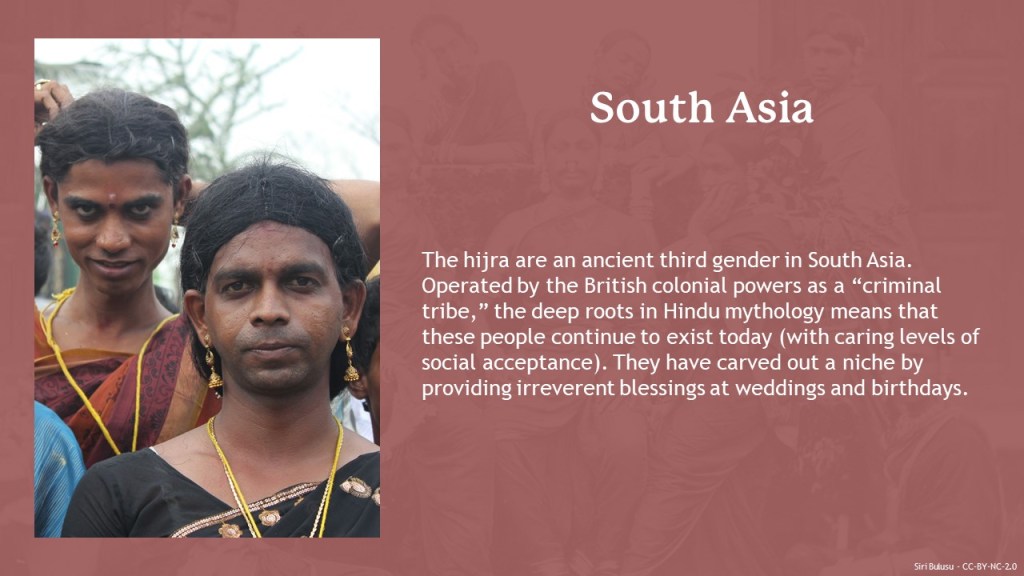
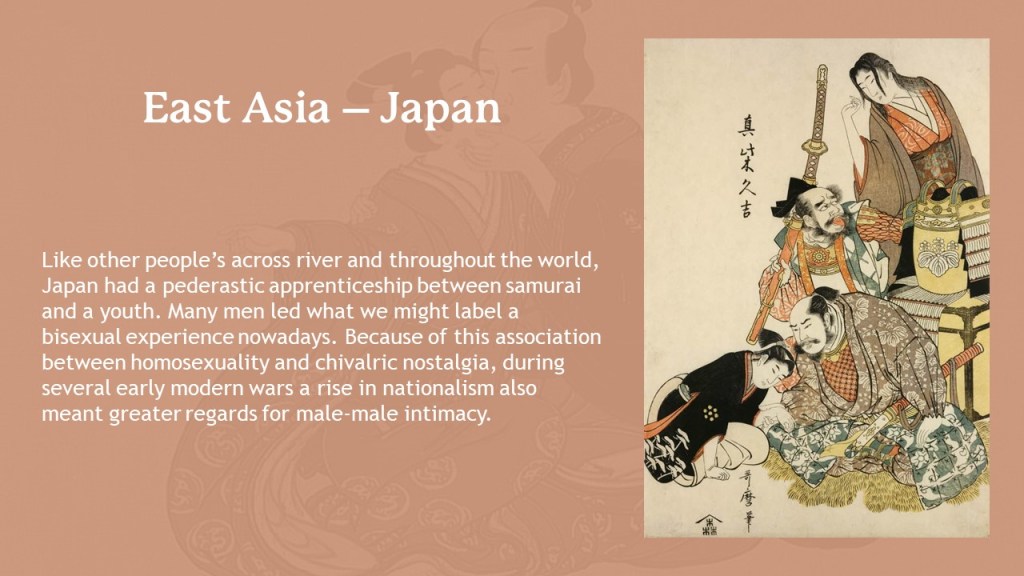
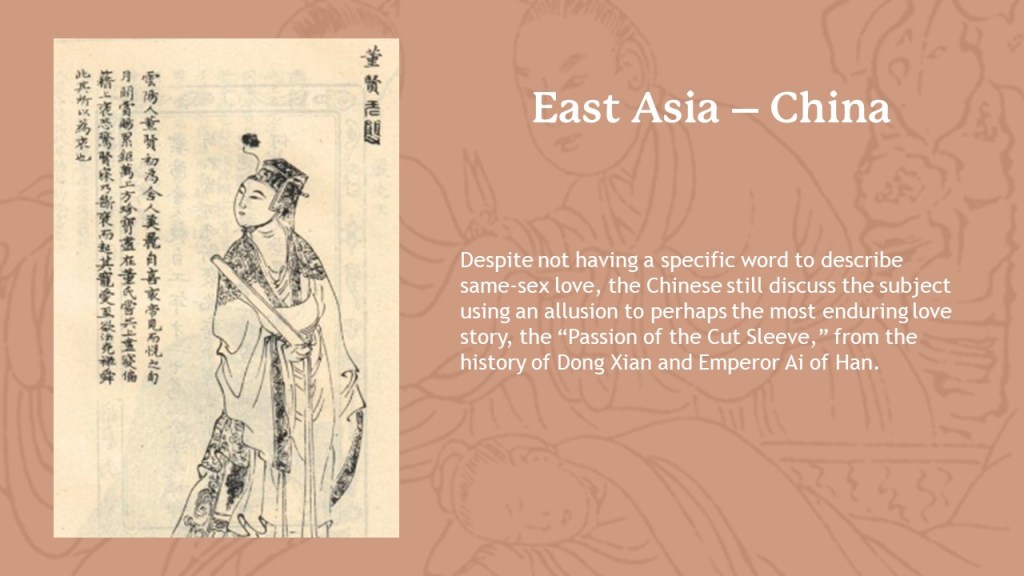
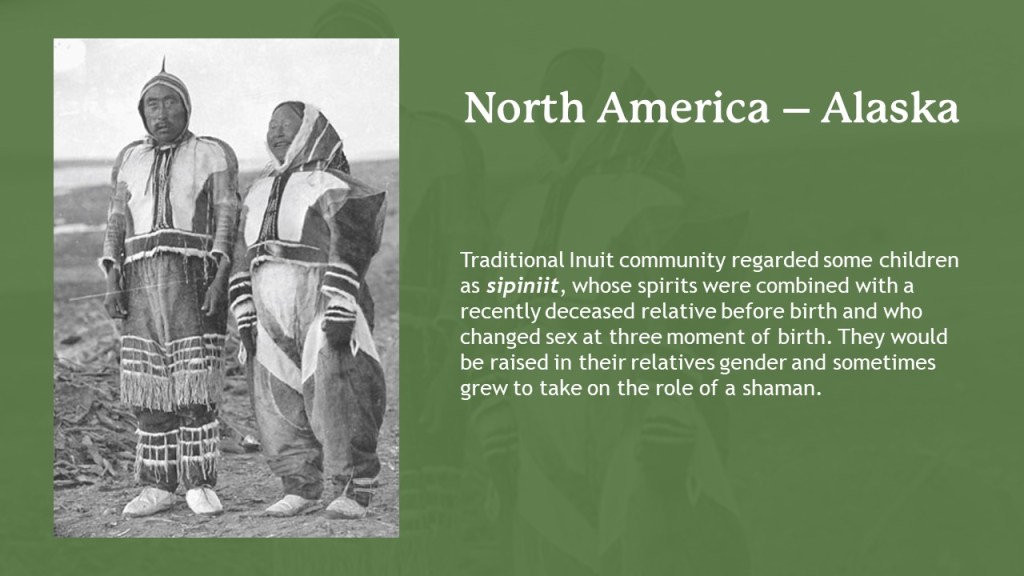
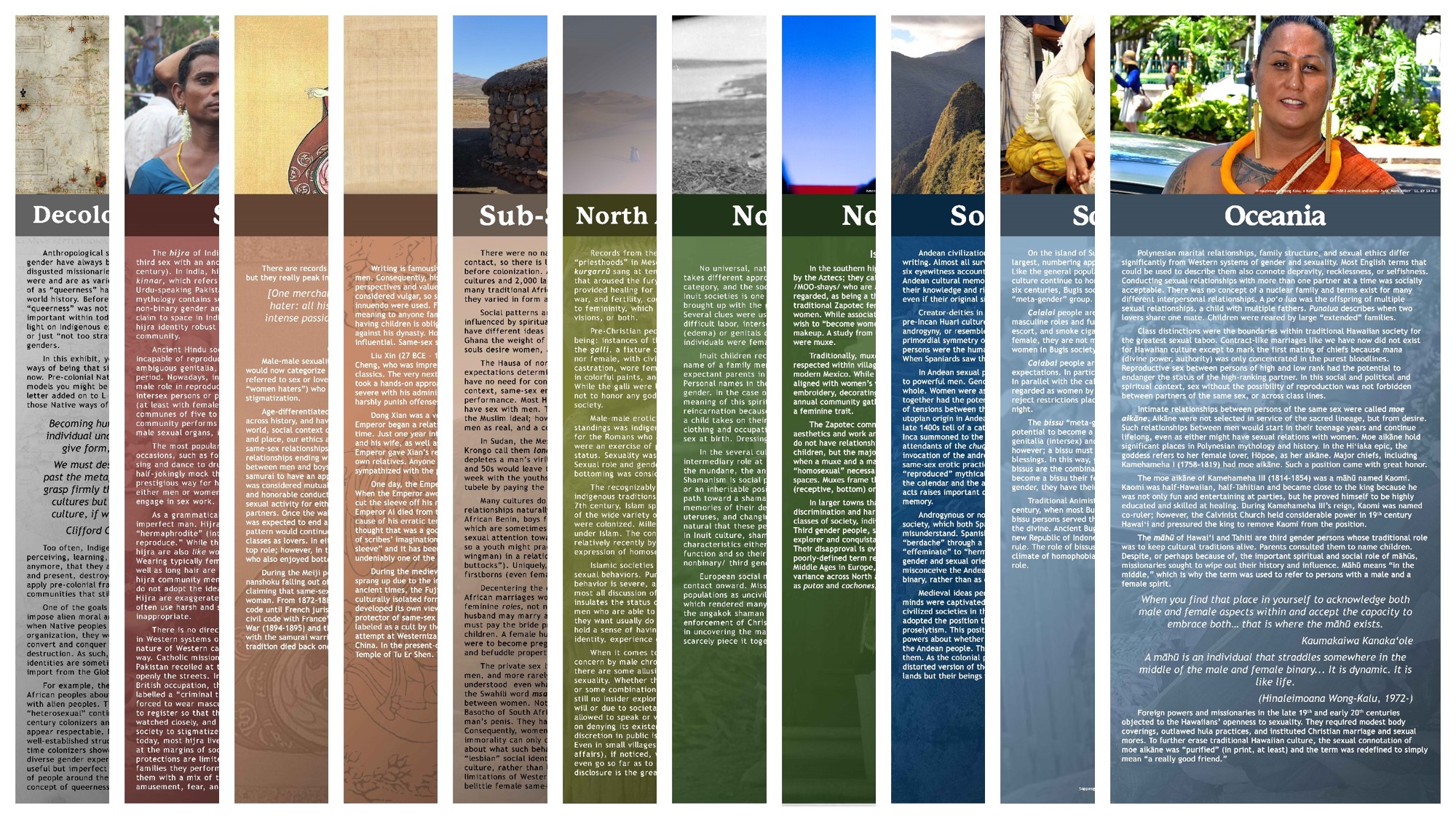
This exhibit explores a slice of the myriad approaches taken to gender and sexuality by cultures and communities around the world. Not only do “non-Western” peoples have different ideas about men and women, several perceive more than two sexes. Rather than judging third gender persons to be horrible or pitiful mistakes, they are seen as being charged with holy purpose and extraordinary abilities. Same-sex erotic behavior can range from no big deal to a typical part of adolescence or of military life to culture-defining inspirational love story. By learning about the sexual diversity of pre-colonial indigenous civilizations, the unspoken assumptions at the root of Western civilization are uncovered.
For those in the West, it is tempting to naturalize and universalize our ways of thinking and being. We often assume that the way things are now is how they’ve always been and the way things are here is how they are everywhere—or, things are better here and now compared with elsewhere and in the past. European colonial powers imposed their attitudes toward gender diverse individuals and same-sex eroticism on the peoples they conquered and exploited across the globe, substituting their “civilized” Christian morality for indigenous knowledge.
Most cultures across time lack so much as a concept of “gender identity” or “sexual orientation,” so it is not useful to try to wedge the incredible diversity of categories that aboriginal peoples use to identify social roles or characterize behavior we might label “sexual” into our contemporary LGBTQ framework. Every group, even in the West, has multiple accounts of what kinds of humans exist, how they came to be, what they exist for, and why it matters. It is also impossible (and inappropriate) to claim the mantle of an identity from a culture outside your own. However, the existence of those identities and ways of being can inspire us to break down the myths of imperialism and claim new space in our own cultures.
Occasions for display:
May 21
World Day for Cultural Diversity for Dialogue and Development
August 9
International Day of the World’s Indigenous Peoples
October
Indigenous Peoples’ Day
November 16
International Day for Tolerance
December 20
International Human Solidarity Day
Number of pieces:
11 banners
Est space:
33 linear feet
(187 sq ft)
Debut:
2023
Testimonials
Rotating the Decolonizing Queerness exhibit over the academic year presented us with unique opportunities for passive and active programming and partnership. Collaborating with multicultural units, academic departments, libraries, and student organizations during heritage & history months and observances; i.e., Latinx Heritage Month, LGBTQ+ History Month, Native November, Black History Month, Middle Eastern & North African (MENA) Heritage Month, Trans Day of Visibility, and Asian Pacific Islander and Desi American (APIDA) Heritage Month. By hosting the exhibit in the Center, we witnessed increased traffic from students and community members alike. I believe Decolonizing Queerness inspired students toward research of their own.
Warren Scherer, MPH
Assistant Dean of Students & Director, UW-Madison Gender and Sexuality Campus Center
Further reading:
Bertolt, Boris. “The invention of homophobia in Africa.” Journal of Advances in Social Science and Humanities, vol. 5, no. 3, 2019, pp. 651-659.
d’Anglure, Bernard Saladin. “The ‘Third Gender’ of the Inuit.” Diogenes, vol. 52, no. 4, 2005, pp. 134-144.
Hamer, Dean and Joe Wilson, directors. Kumu Hina. Qwaves and ITVS, 2014.
Horswell, Michael J. Decolonizing the sodomite: Queer tropes of sexuality in colonial Andean culture. University of Texas Press, 2006.
Leupp, Gary. Male colors: The construction of homosexuality in Tokugawa Japan. Univ of California Press, 2023.
Graham, Sharyn. “Sulawesi’s fifth gender.” Inside Indonesia, Apr-Jun 2001, https://www.insideindonesia.org/sulawesis-fifth-gender. Accessed 16 Apr. 2021.
Murray, Stephen O., and Will Roscoe, editors. Boy-Wives and Female Husbands Studies in African Homosexualities. SUNY Press, 2021.
Murray, Stephen O., and Will Roscoe, editors. Islamic Homosexualities: Culture, History, and Literature. New York University Press, 1997.
Nanda, Serena. Neither Man nor Woman: The Hijras of India. 2nd ed., Wadsworth, 1999.
Picq, Manuela L., and Josi Tikuna. “Indigenous sexualities: Resisting conquest and translation.” Sexuality and Translation in world politics, edited by Caroline Cottet and Manuela Lavinas Picq, 2019, pp. 57 – 72.
Roncagliolo, Santiago, and Gisela Antonuccio. Muxes. HBO Max, 2022.
Roscoe, Will. “Priests of the goddess: Gender transgression in ancient religion.” History of Religions, vol. 35, no. 3, 1996, pp. 195-230.
Lesson Plans:
None yet.
 VINCE.lgbt